What is a rail loadout, and why its expansion signals a ramp
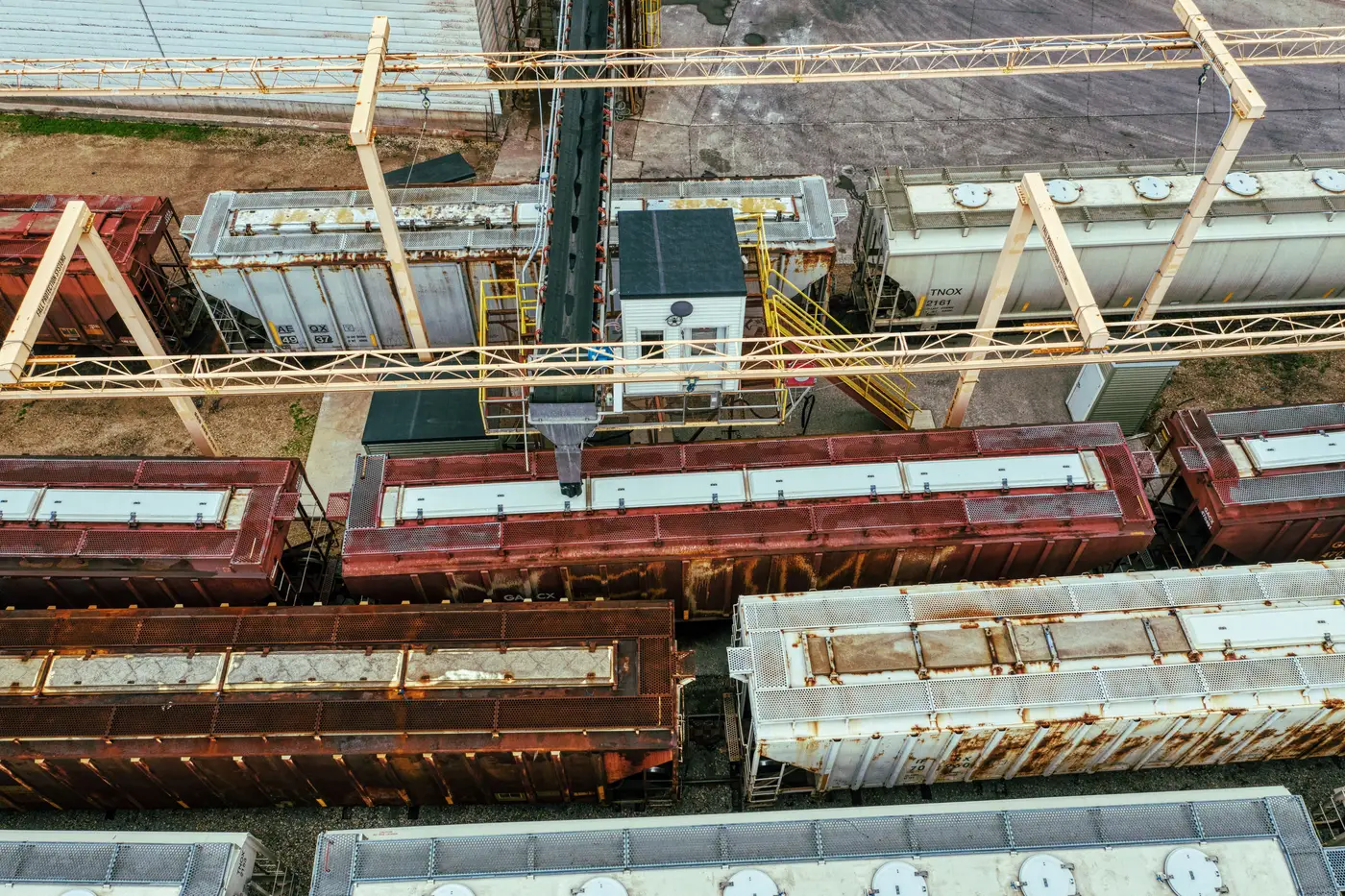
A rail loadout is the point on a mine site where processed ore, concentrate, or coal gets dropped into rail cars for the trip to port, smelter, or mill. It's usually a fixed structure: a load-out bin or silo sitting over a stretch of track, fed by conveyor from the stockpile, with a loop or balloon track below it so a unit train can pull through without having to be broken up and shunted.
The loadout's size gets engineered to a throughput number: bin capacity, loop length, and number of load points all get sized against a planned annual tonnage and a target train turnaround time. That's why an analyst who tracks mine infrastructure cares about this one structure more than almost anything else on site.
The pit tells you what a company plans to dig. The plant tells you what it plans to process. The loadout tells you what it plans to actually move off the property, and that's the number that eventually shows up as supply.
Why loadout capacity gets built ahead of guidance
Permitting and construction on rail infrastructure runs long. A second loop track, an extended siding, or a new load point has to be designed, approved, and built before a single extra tonne can leave site, which means the construction has to start well ahead of any production increase it's meant to support. Companies rarely put out a press release that says "we've lengthened our rail loop to handle 20 more cars per train." It's capex that shows up in an annual report as a line item, if it shows up at all, long after the dirt has already moved.
That gap between "the siding got longer" and "guidance went up" is the window an analyst can work in. A mine running at nameplate capacity on its existing loadout has a hard ceiling. It can mine more, stockpile more, even commission a plant expansion, and still be bottlenecked at the point where ore meets rail car. So when a competitor starts pouring concrete for a second loop, extending ballast beyond the existing turnout, or adding a parallel load point next to the original bin, that's a company removing its own bottleneck. It's a tell that someone in the business has already modeled a production rate the current loadout can't support.
What the expansion actually looks like on the ground
The physical signs are fairly consistent across sites. A loop track gets lengthened, or a second loop gets graded in parallel to the first. A new load-out bin or silo appears near an existing stockpile, sometimes before the stockpile itself has grown. Stacker-reclaimer additions start feeding into a loadout that previously ran off a single conveyor. The train consist itself is worth watching too: a longer string of loaded cars sitting in the loop on a given pass is a rougher but still useful read on whether the existing infrastructure is being pushed harder before any physical expansion starts.
None of this is a guarantee. Capex gets delayed, projects get shelved, a loop that's half-graded in one quarter can sit untouched for the next three. That's exactly why it's a leading indicator and not a confirmed number, and why it needs to be checked site by site, quarter by quarter, rather than assumed from a single image. A per-site change log that tracks pit, plant, and rail infrastructure together, the kind of thing Competitor Capacity builds from quarterly high-resolution passes, is what turns a single loop-track sighting into an actual read on a competitor's production trajectory.
Rail loadout expansion is one of the more reliable physical tells in competitor capacity work because it's expensive enough that companies don't build it speculatively, and visible enough that it doesn't require an inside line to a procurement department. It shows up in the imagery months before it shows up in a filing.
If you'd rather see a competitor's rail siding growth flagged in a quarterly change log than catch it three quarters late in an MD&A, that's the problem this product exists to solve.